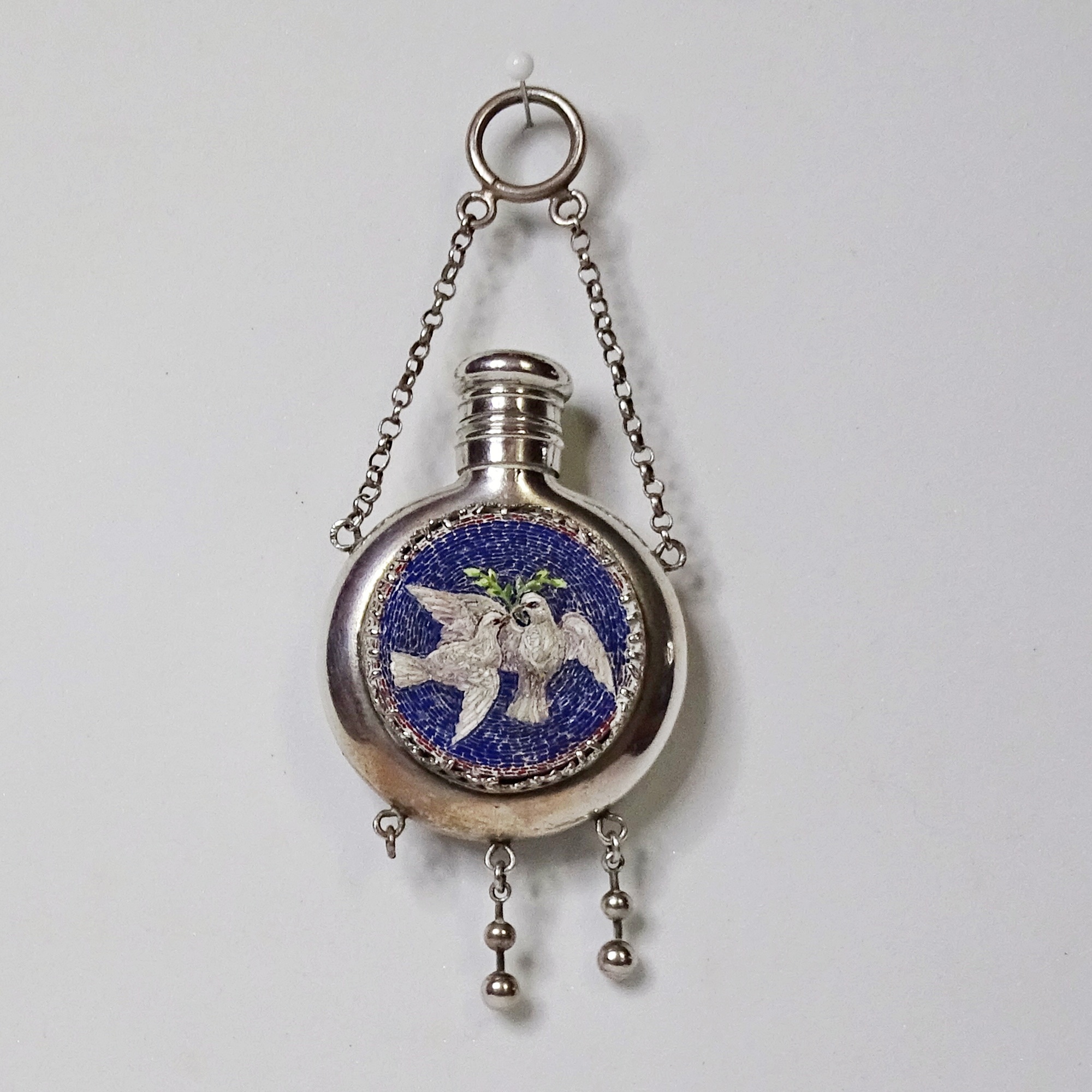
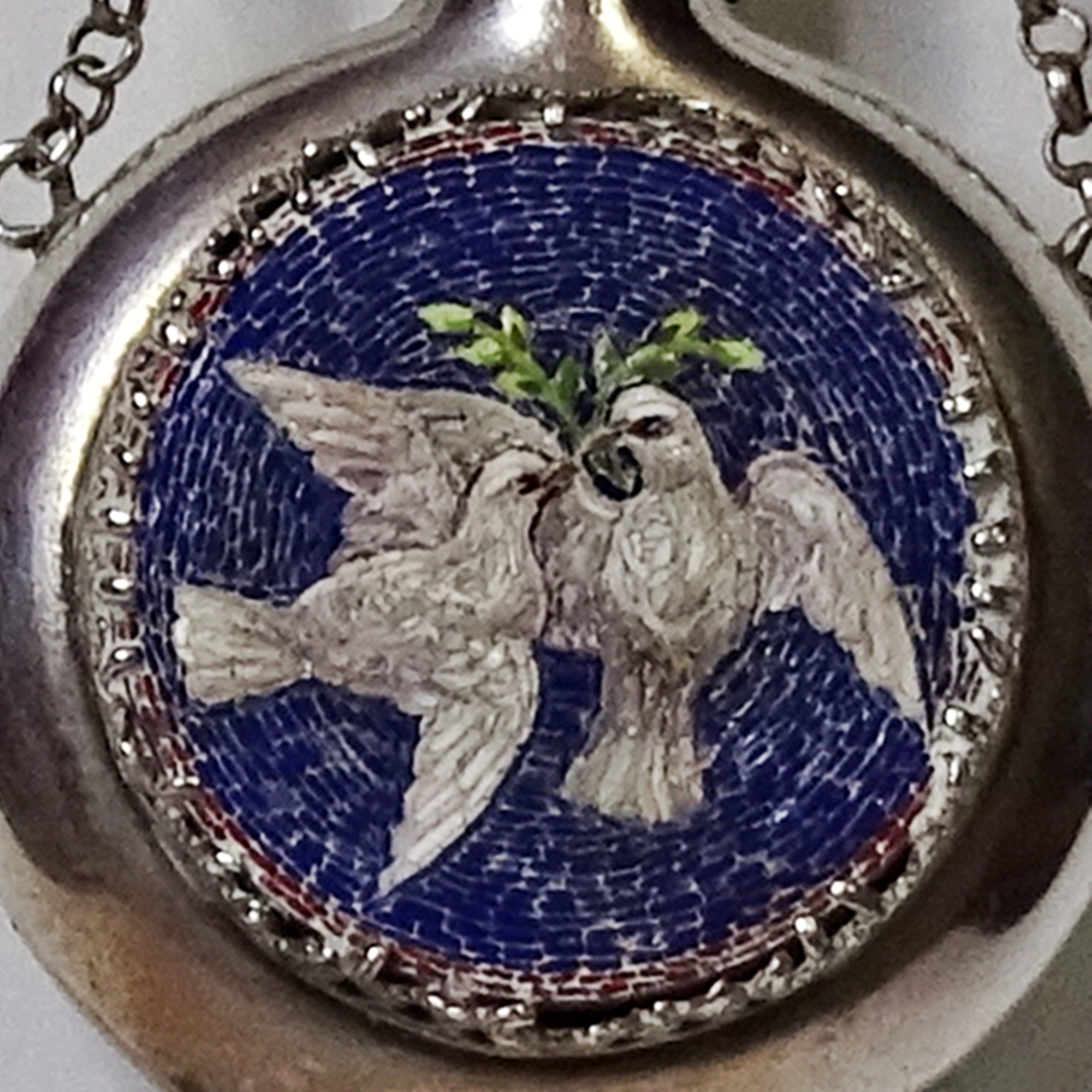
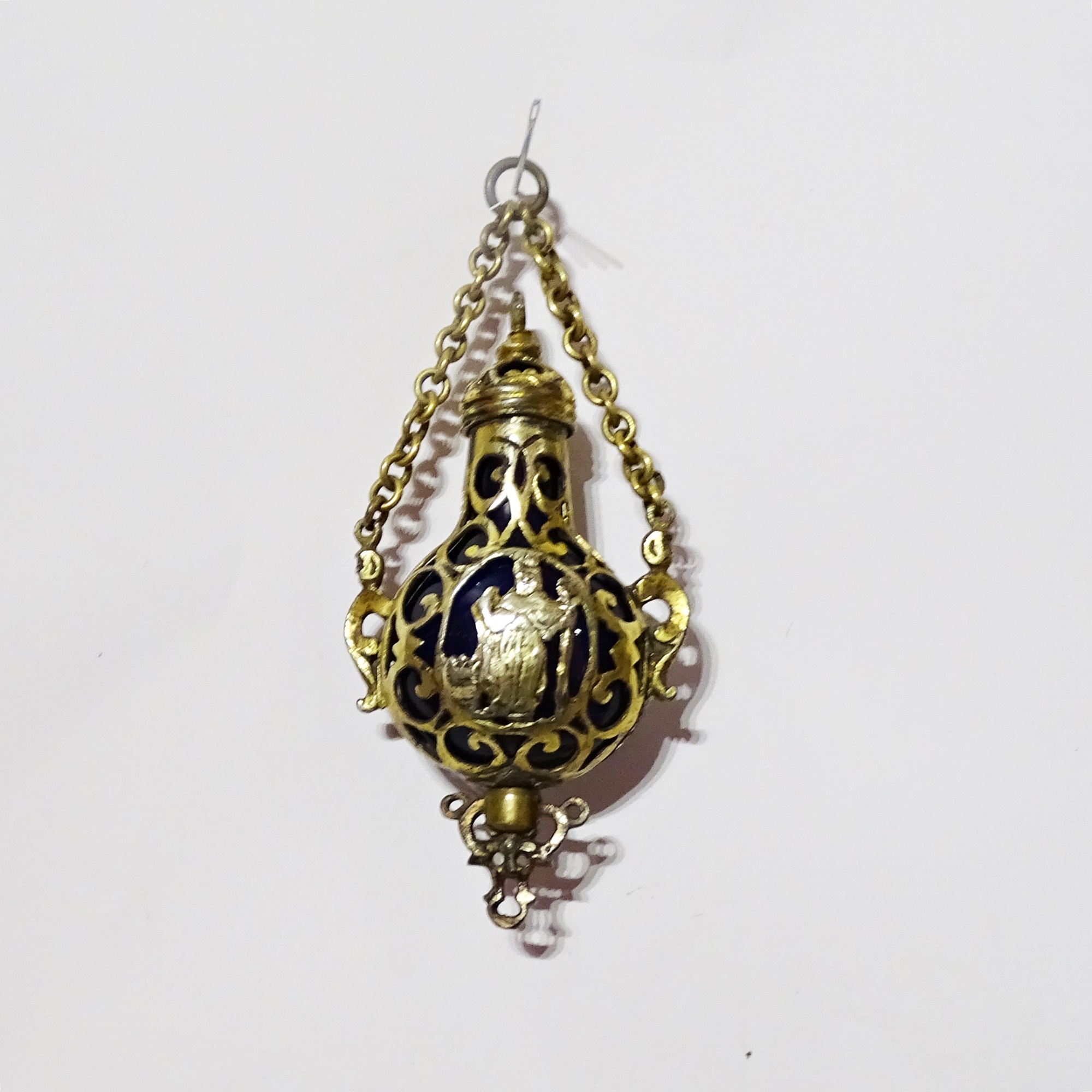
Silver pendant scent bottle decorated with a splendid central medallion in glass micromosaic. This specific type of craftsmanship is typical of Venetian artistic craftsmanship dating back the Umbertine era. The central section features a fine mosaic of tiny tesserae (called filati vitrei) against a deep cobalt blue background. It depicts two adjacent white doves, one clutching a green sprig in its beak. The round flask is topped with a screw cap. Suspension chain and ring that allowed it to be hung from a chatelaine or worn as a pendant. Small tangles with hammered silver beads are attached to the lower section, an ornamental detail typical of 19th-century revivalist goldsmithing.
Pliny’s Doves (or the Mosaic of the Doves) is a famous ancient mosaic created in the *opus vermiculatum* style (using tiny tesserae measuring approximately 0.5 mm) dating back to the Roman era; it is currently housed in the Hall of the Doves at the Palazzo Nuovo within the Capitoline Museums in Rome. It depicts four doves perched on the rim of a bronze *kantharos* (a type of vessel or basin) filled with water. One is drinking, casting a shadow on the water with its head; another is preening its feathers; and the remaining two are resting.
The artwork (measuring 85 x 98 cm) was discovered in 1737 during archaeological excavations at Hadrian’s Villa (Tivoli), set into the floor of a room.
It takes its name from a description by Pliny the Elder in his *Naturalis Historia* (Book XXXVI, 184), in which the author mentions a famous Greek mosaic on the same subject created by the artist Sosos of Pergamon in the 2nd century.
Due to the extraordinary precision that gives it the appearance of a painting, the original became immensely famous and was endlessly reproduced throughout the 19th century as a favorite subject for Roman micromosaics, jewelry, and Grand Tour souvenirs.
Period
Late 19th century
Venezia, Italy, 1870 ca
Glass and metal
3 cm Ø
COD.
1310