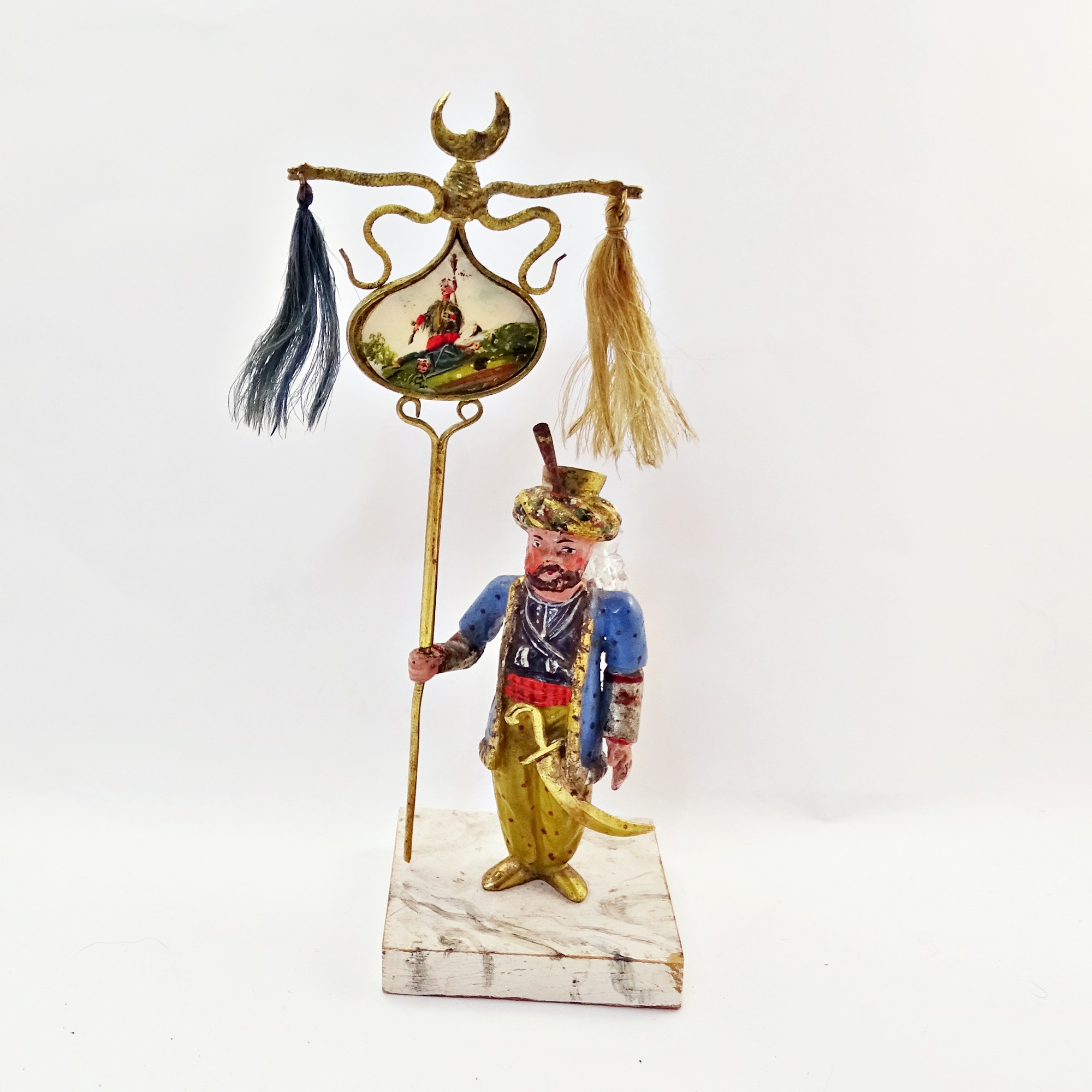
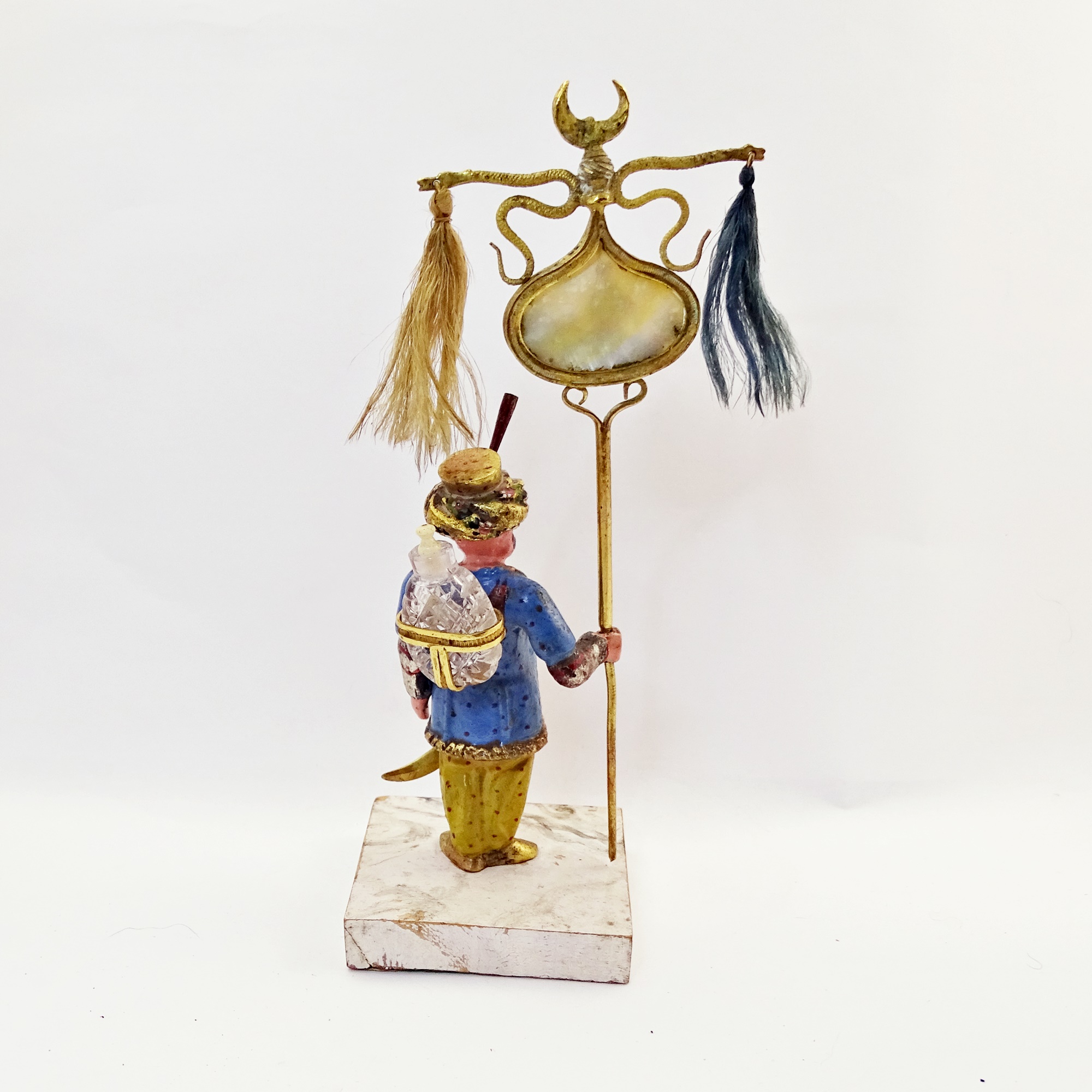
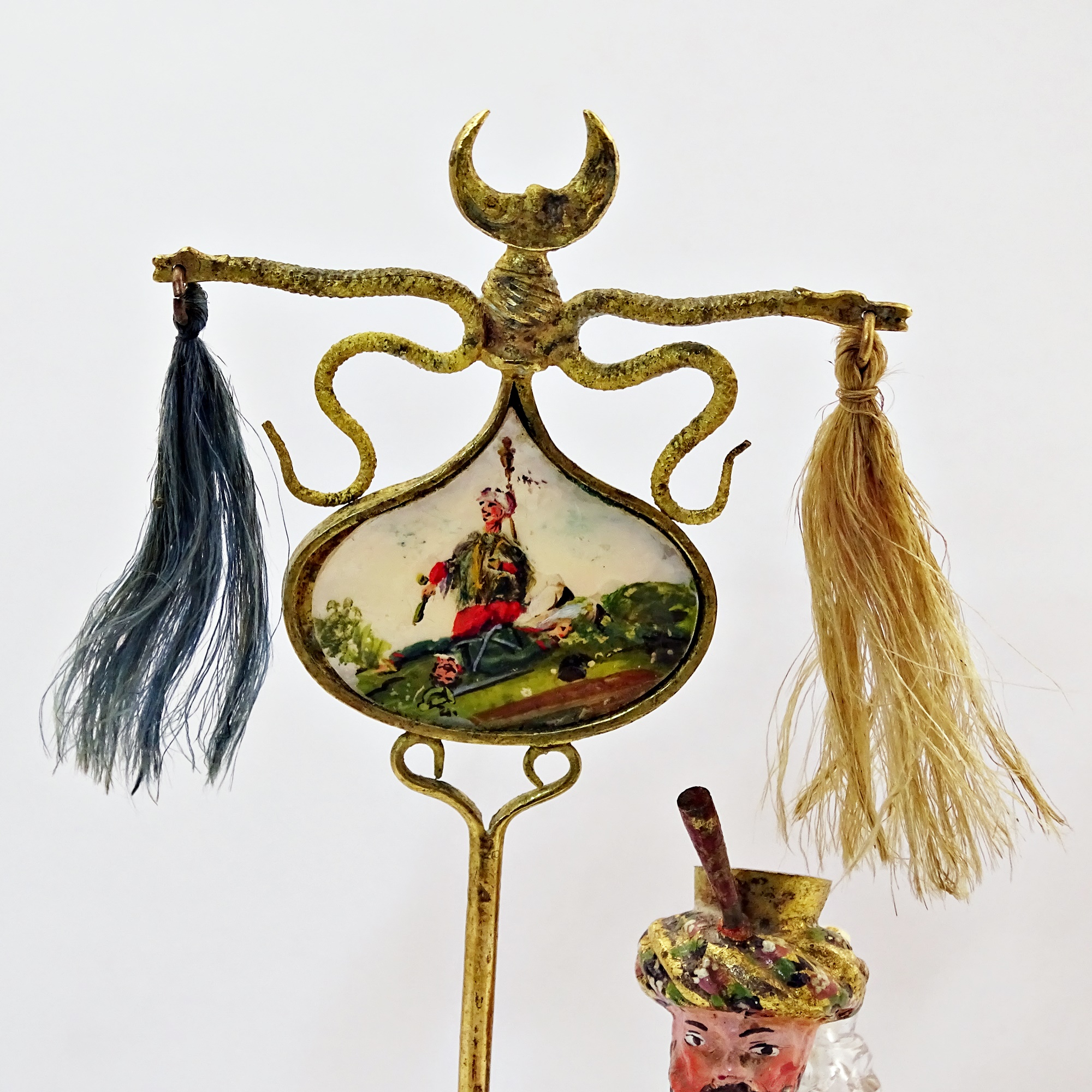
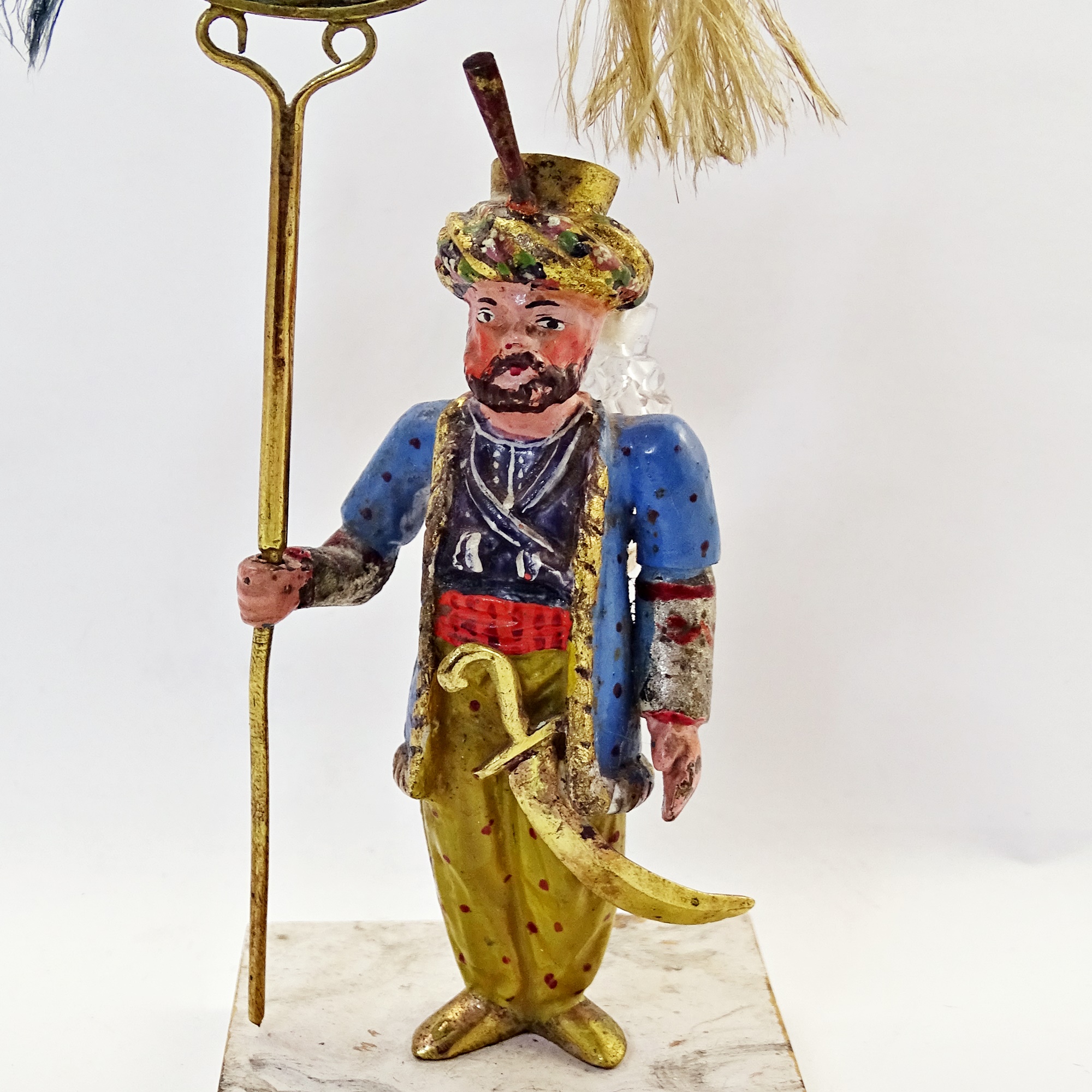
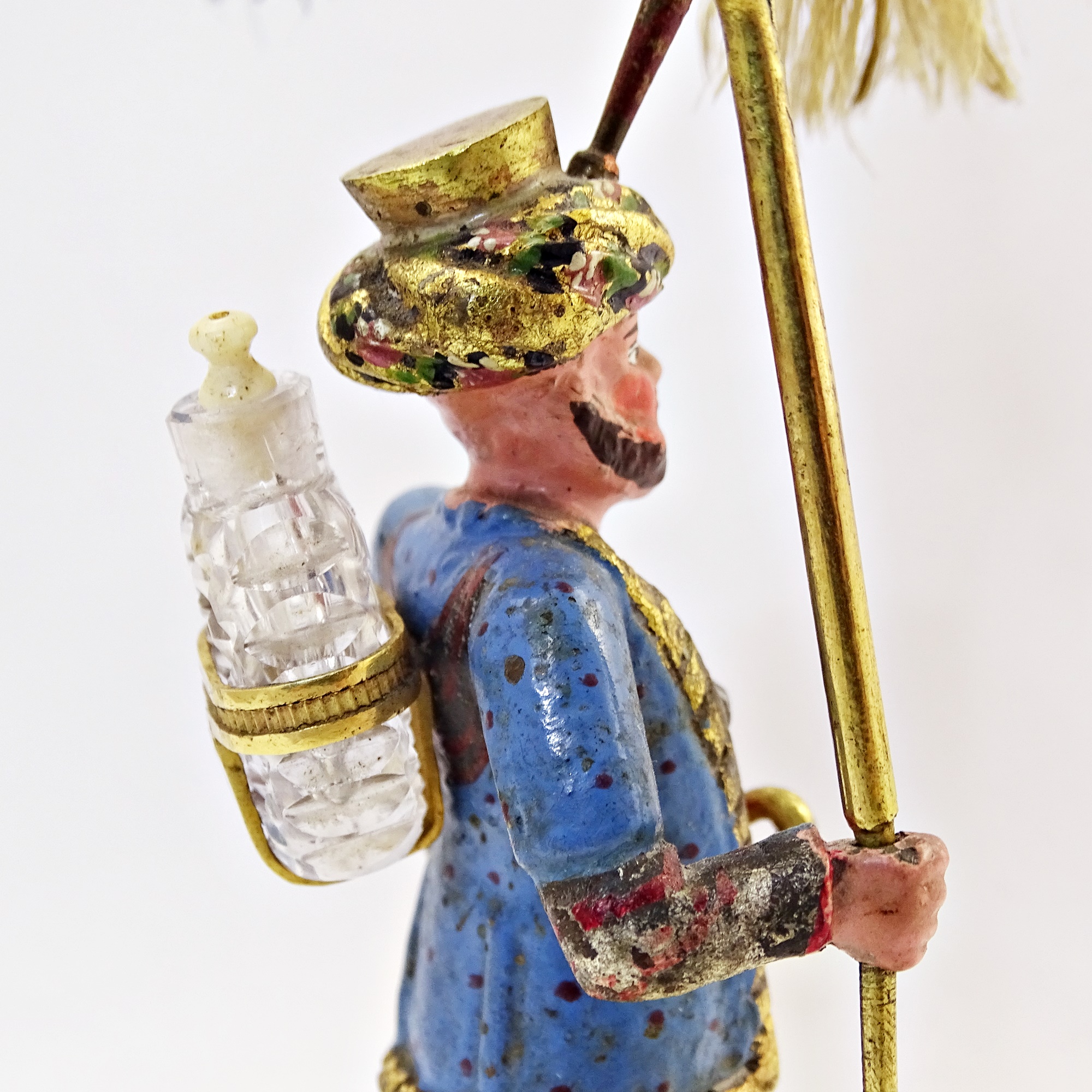
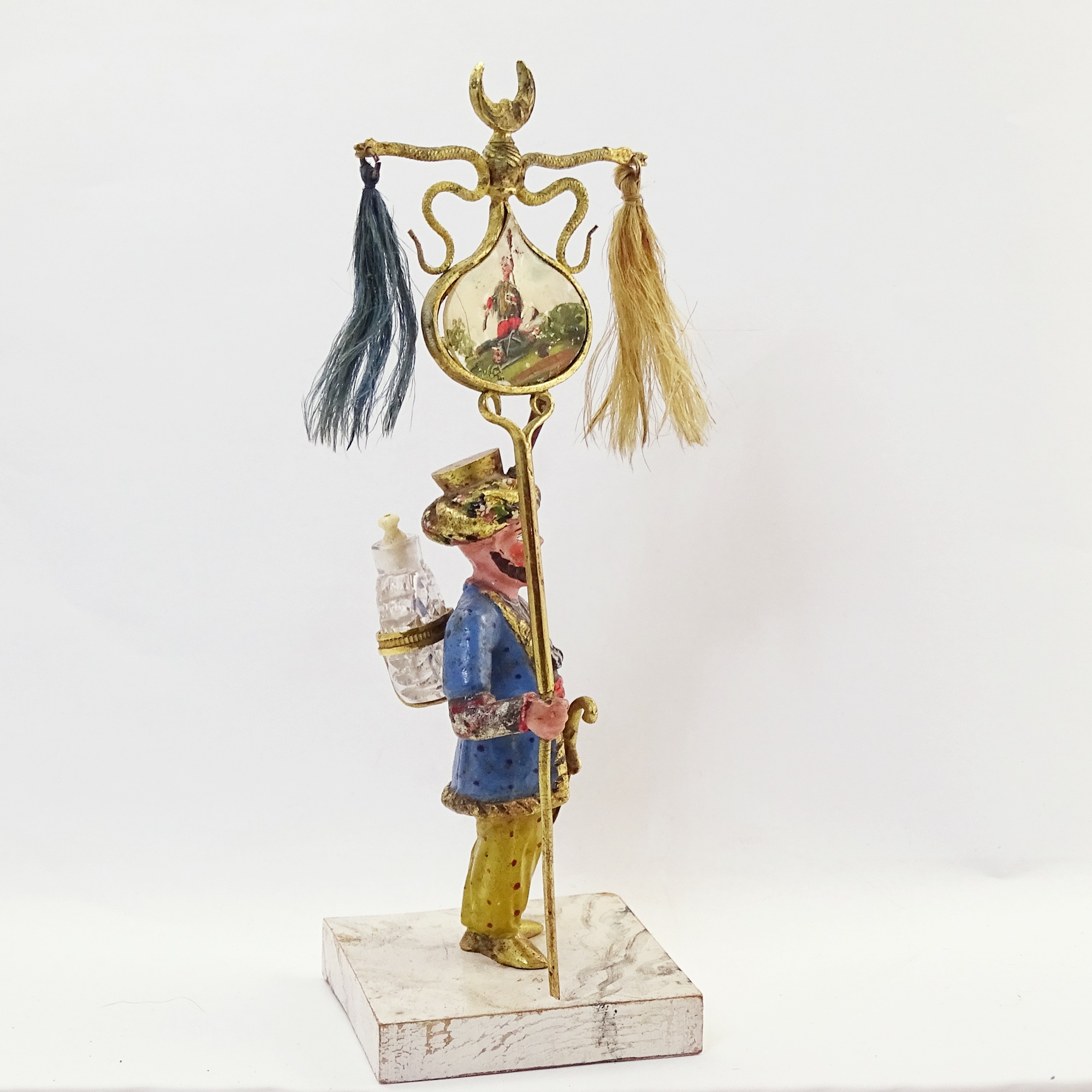
Lead soldier (quite heavy), hand-painted with colourfull details and costume, on a wood base, painted to look like marble. Instead of the backpack he carries on his shoulders a small scent bottle in cut crystal with an ivory cap: the support of the bottle is made with thin gold bands. The labarum is painted on a mother of pearl medallion and it shows a dead soldier, in European uniform, killed by the Ottoman soldier.
The soldier certainly represents an Ottoman high officer. The costume is typical of a Balcanic powerful man, with wide trousers, a sash and a turban, and the fur-lined jacket suggests a high rank, as does the golden scimitar. The silver elements that emerge from the sash, painted and in relief, represent the handles of yatagan-type daggers, a typical element of Balkan military costume, in fact most of the members of the Ottoman army were originally from the Sultan’s European possessions.
That sort of labarum held in the hand by the figurine represents a çevgen or “Turkish crescent”, an object that was at the same time the symbol of a military unit, similar to Western standards, and a musical instrument similar to a sistrum. The instrument is decorated on the sides with two tugs, horsehair tails, which represented the prestige of the military unit and the authority that the Sultan had invested his commander with (a remnant of the era when the Turks were mounted warriors in the Asian steppes).
In the miniature painted on the çevgen, you can always recognize a Turkish warrior (the “pole” behind him is always a tug, with the horsetail gathered for battle) and a European soldier fallen to the ground. It could certainly be a Russian soldier, given the green uniform with red lapels, but it could also be an Austrian cavalryman. The sword in particular and the hint of black knee-high boots would lean towards cavalry, and the black object on the bottom right could be an Austrian leather helmet, which began to replace the tricorne hat in the mid-18th century. However, the white baldric should be only one, even if we are in an era in which the individual equipment of the soldier was far from being standardized. Both the Russian and Austrian empires fought incessant border wars with the Ottomans throughout the 18th century, so both hypotheses are plausible.
The production of this object should be placed in the second half of the eighteenth century, given that the Austro-Turkish wars, which began in 1716, ended in 1791 with the Peace of Sistova.
Period
18th century
Ottoman Empire, 1760 ca
glass and metal
2 cm
COD.
1057
Consulence by Marco Maccatrozzo