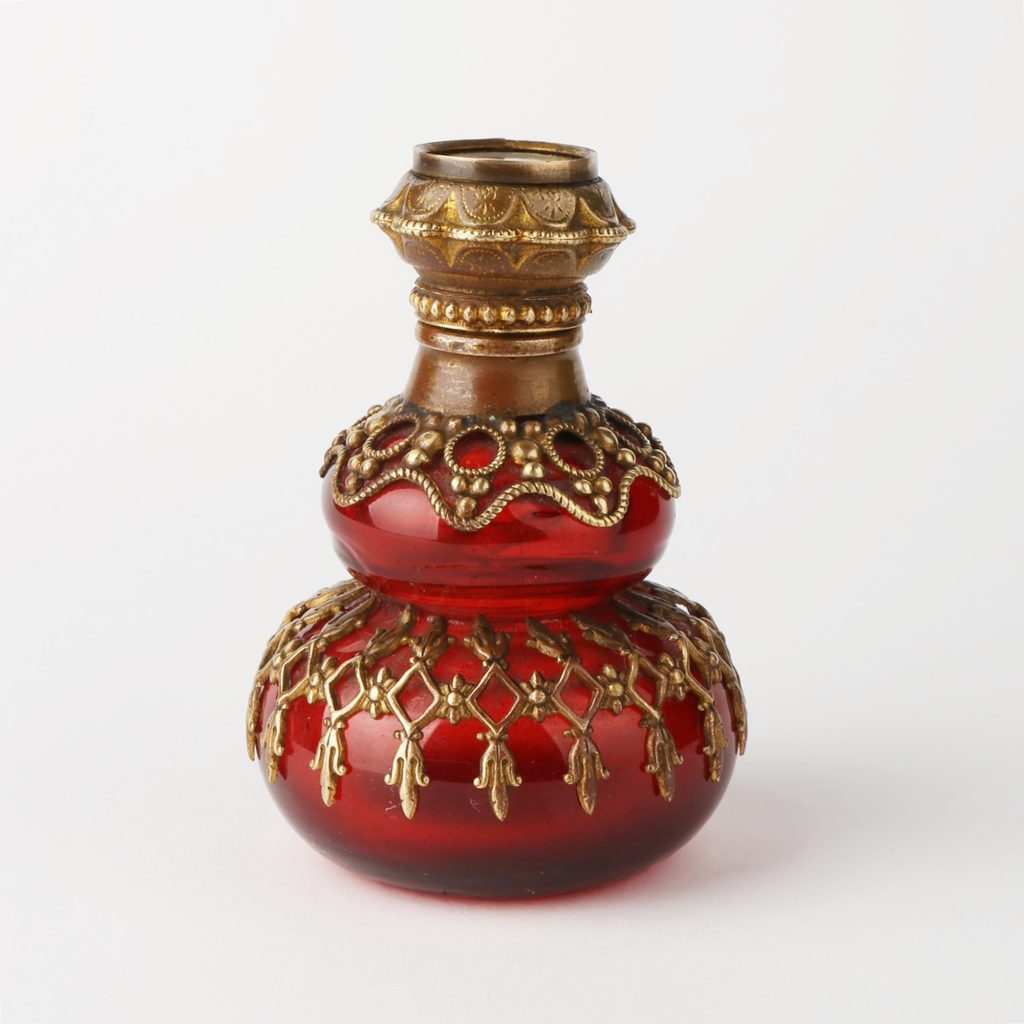
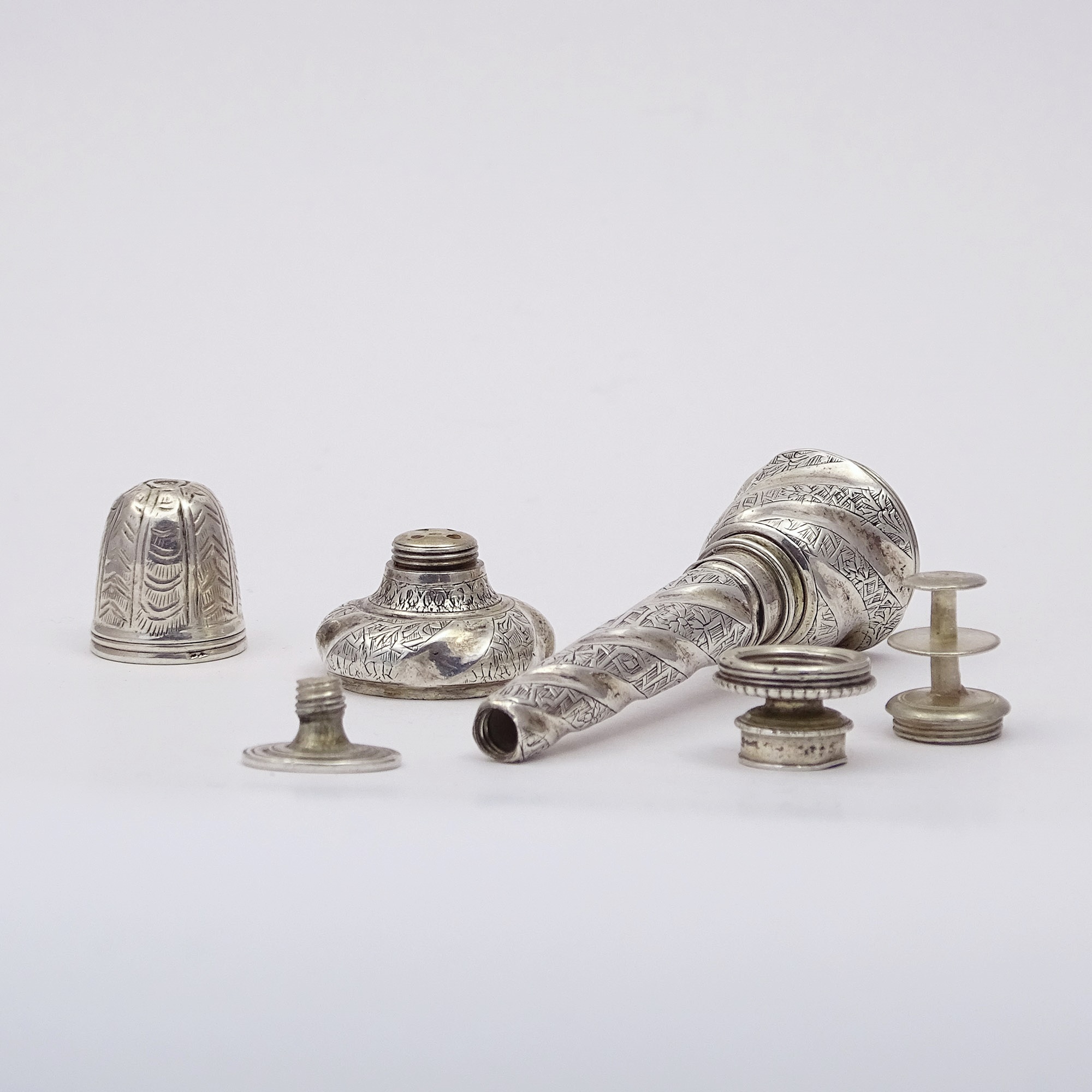
Collecting antique scent bottles, I find myself frequently to face the problem of dating every new piece I add to my collection. The greatest dream of every collector of antique objects is that they could tell their own history: who made them, where and when, and who were their owners along the passage of time. Some of them give us many indications, especially the ones which I call “self dating” as the date is clearly indicated on the bottle or refers to a very specific event.
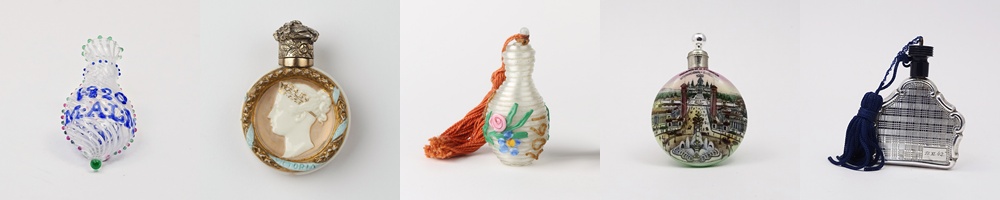
Others can be collocated in a frame of time and scene as correct as possible because of the style, the comparison with similar objects found in the books or in the Web and a good knowledge of the pieces that are our passion while being aware that the margins of error are often very high. This can explain why the market proceeds by generalizations: so many pieces are just defined ‘Victorian’ -such a long reign makes it easier to be right-, or why every painted glass bottle is ‘Moser’ or ‘Murano’ if colourful, or why so many porcelain ones are ‘perhaps Meissen’.
Place a scnt bottle in a correct frame of period and place is a wide and infinite theme and I could never produce something exhaustive, but give only a few indications.
1ST CHAPTER: METALS
SILVER. Everything is easy when we come to English silver: a series of punches, if not deleted by a hectic cleaning activity that sometimes characterizes certain ladies, tells us where, when and by whom the object was produced.
English law for silver marks began in 1300 under King Edward I, mandating sterling silver (92.5% pure) be marked by Goldsmiths’ Guild to guarantee purity, evolving with mandatory maker’s marks (1363), assay office marks, date letters, and temporary duty marks (1784-1890) for tax, forming the oldest consumer protection, with modern laws like the Hallmarking Act 1973 ensuring continuity through Britain’s Assay Offices (London, Birmingham, Sheffield, Edinburgh).

1876 Birmingham 1882 London 1888 Birmingham 1902, Chester 1905 Birmingham 1921 London
Even when a bottle is made of porcelain, glass or other material, a hallmarked silver cap gives us some fundamental elements to circumscribe the period of production. This is practically the only case in which we have such precise indications.
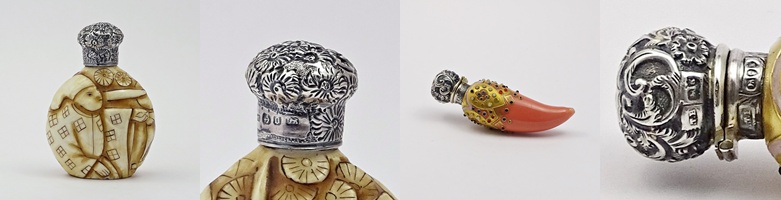
Other European countries have enacted similar laws over time, but the hallmarks are often not as defined, legible, or clear as British ones. French silver has tiny, often illegible hallmarks; Italy didn’t have a silver law until 1939; Northern European countries have a complex variety of hallmarks, not as easy to read. Identifying a hallmark is often a matter of luck, not always knowledge.

A very high percentage of the bottles in my collection therefore have no certain date: those made of precious metals that are not hallmarked (the corks are often too small to affix a hallmark), all those made of metal alloys or silver-plated. In these cases, and in all those made of porcelain, glass, or other materials, the style, technique, comparison, and the need to run the risk of limiting a production period remain.